
Finding Plano Residents From Records
Plano has no single public list of every person at every address. The useful route changes with the question. Start with Collin County Central Appraisal District, or CCAD, when an address or likely owner is known. Its record can tie the physical parcel to a legal description and an owner mailing address. Use the state voter lookup only to confirm a particular registration. For a past household, the strongest clue may be a city directory, a newspaper notice, or a probate filing rather than a current screen.
Keep the role of each result clear. A property card identifies an appraised owner, not every person who stays there. A deed identifies parties to a recorded instrument. A voter result concerns registration. A historical directory can identify an occupant or business at publication time. The most reliable Plano resident search matches at least two independent details, such as an address and middle initial, or a legal description and recorded document number.
- Search a known Plano address or owner name in CCAD and note the property ID, situs address, and legal description.
- Use the legal description, owner, or document number in the County Clerk deed index if the question concerns a parcel transaction.
- For a named voter, use the state portal with the required name, county, date of birth, and ZIP information.
- Check the appropriate court index for a case number, then ask the clerk for the file when a full record is needed.
- For a historic person or address, compare UNT directory scans, library materials, and newspaper evidence before drawing a conclusion.
Plano Resident Records Offices
Plano is in Collin County, but McKinney is the county seat. That split matters. The County Clerk keeps recorded land instruments and several county record groups, CCAD maintains the appraisal roll, and Collin County Elections handles registration matters. City departments keep their own municipal files, including permits and municipal court records. The county public-records office map is useful when a request could belong to the city, a clerk, an appraisal office, or an originating law-enforcement agency.
Collin County Clerk
Land recordings and copy requests
2300 Bloomdale Rd, Suite 2106
McKinney, TX 75071
Collin County Central Appraisal District
Property cards, parcel identifiers, legal descriptions, and appraisal data
Public property search updated nightly
Collin County Elections
2010 Redbud Blvd, Suite 102
McKinney, TX 75069
972-547-1990
The County Clerk's Plano office is currently closed until further notice because of flooding. For clerk services, use the online route, mail or the McKinney counter instead of assuming the Plano office can accept a visit. For an address-by-address trail, use the Plano street directory route after the office and record type are clear.
CCAD's Plano Parcel Search
CCAD is the key first stop for a present-day parcel question. The basic path supports owner and address searching, while Advanced criteria reach property and geographic IDs, subdivisions, neighborhoods, legal descriptions, property type, tax year, and other appraisal filters. Owner names are stored in a last-name-first format, so a simple surname can be more useful than a full formal name. The legacy search also documents street number, street name, suffix, block, tract or lot, city, account status, and sort controls.
The result establishes an appraisal connection, not continuous residence. It can show an owner name and mailing address apart from the situs address, the physical location of the parcel. It can also provide a legal description, property or geographic identifiers, value fields, exemptions, tax year, and inspection information. Legal description and acreage are appraisal references, so a deed or plat is the better source for a legal conclusion.
| CCAD field | How it helps a Plano search |
|---|---|
| Owner Name | Search a likely owner, using the last-name-first format when needed. |
| Street Number and Street Name | Locate a physical parcel when an address is known. |
| Property ID or Geographic ID | Preserve a stable parcel reference for later checks. |
| Subdivision and Legal Description | Bridge a street address to the County Clerk instrument index. |
| Tax Year and Property Type | Keep the appraisal context and selected record set clear. |
CCAD's property-search screen is shown below with its owner and advanced-search starting points.
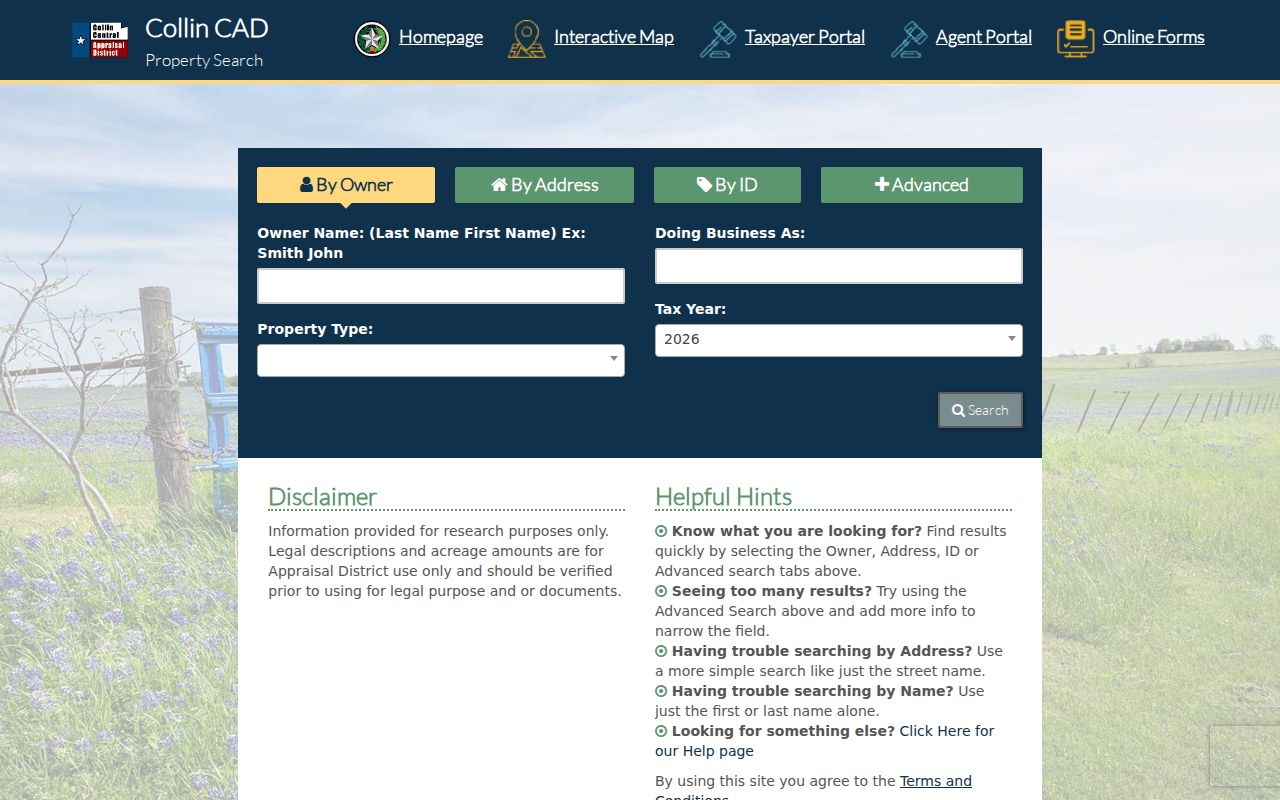
Use the returned parcel identifiers and legal description as notes for the next official record, rather than treating a single card as a household roster.
Plano Voter Registration Clues
Texas My Voter Portal is a narrow confirmation tool. It asks for a first name, last name, county, full date of birth, and five-digit ZIP code. A matching result can return registration status, a Texas voter unique identifier, name, county, precinct or district context, and polling or early-voting information. It does not reveal a ballot choice, and it is not an anonymous address directory.
Collin County also offers a paid voter file through its Election Store. The research documents registered and mailing addresses, districts, registration dates, active or suspense status, and participation history in that file, while phone numbers and email addresses are not public there. Election Code restrictions apply, protected voter information is suppressed, and no public request requires the county to make a custom street roster. Treat a suspense status as an address-confirmation issue, not a conclusion about a person.
Plano Deed Records Follow Parcels
Recorded land instruments can connect names to the history of a Plano parcel. The County Clerk instructions describe the practical bridge: obtain the legal description from CCAD, then search by party name, document number, or the available legal-description details. A grantor is the party transferring an interest. A grantee is the party receiving it. Recording dates, document numbers, instrument type, and the legal description help distinguish a true parcel trail from a same-name result.
The current online index is useful, but its earliest online year is not published. The Clerk also warns that the web database is not the official repository and that some information can be redacted under HB 4350. A missing online hit does not establish that no historical instrument exists. Ask the Clerk about manual books or microfilm coverage, and use a copy request or the public counter when an official image or certified copy matters. The fee schedule documented a $10 name, legal, or document search, with copy and certification charges stated separately.
- Parcel
- A mapped piece of property identified in the appraisal system.
- Situs address
- The physical location of that parcel, which can differ from an owner's mailing address.
- Legal description
- The lot, block, subdivision, or other land description used to connect appraisal and recorded-land records.
- Index
- A finding tool that points to a record. It is not always the complete official instrument or image.
The County Clerk land-recordings page supplies the official search, copy-request, and fee-routing information.
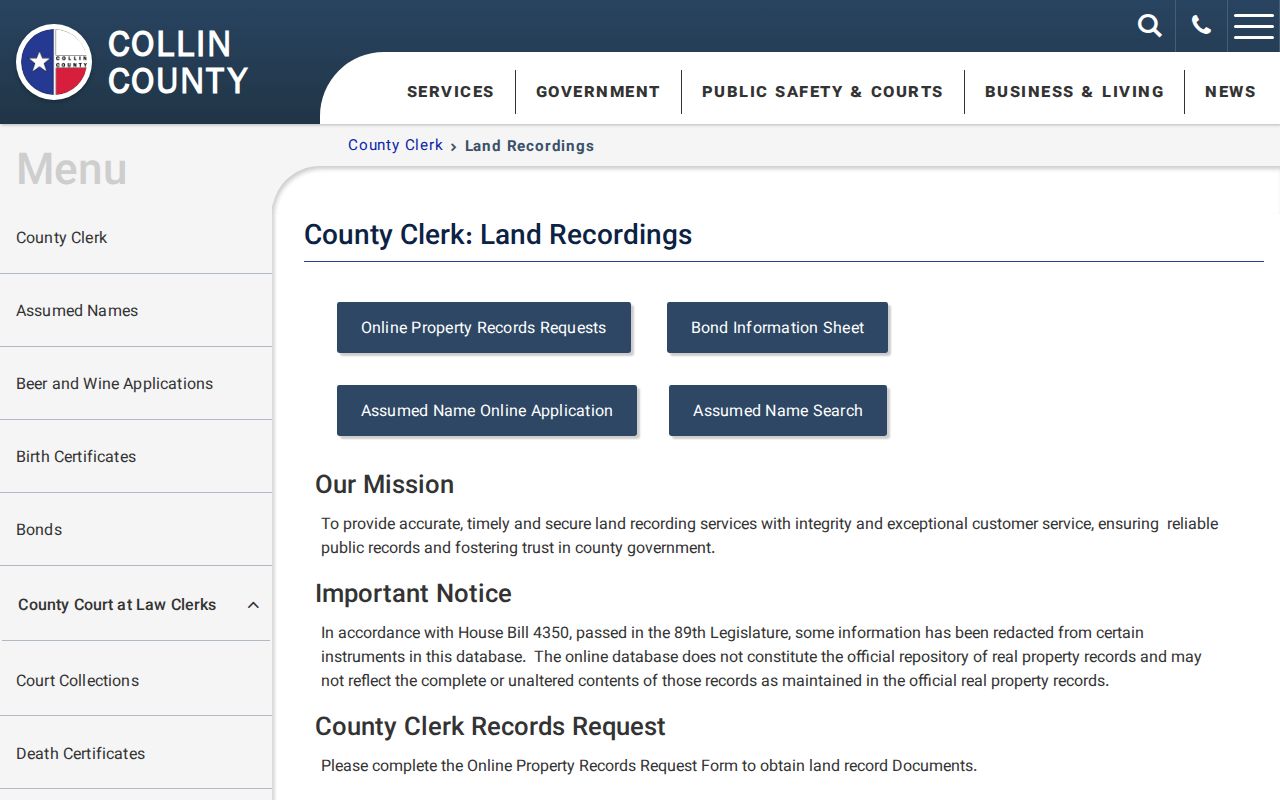
That route makes the document number and copy request part of the record trail, which is safer than relying on a partial web result.
Current Plano Resident Directories
Current directory-like sources are role-specific. The appraisal roll is strongest for a recorded owner and parcel context. A voter result concerns registration. The deed index captures people appearing in an instrument. Courts identify parties and case locations, while a city staff directory merely helps route a request to a Plano department. Neighborhood and association records can identify public civic contacts or a legal association, but they are not member lists.
| Plano source | Record role | Keeper | Access route |
|---|---|---|---|
| CCAD property roll | Appraised owner, parcel, mailing and situs context | CCAD | Free online search, updated nightly |
| My Voter Portal | Individual registration status and voting context | Texas elections system | Name, county, DOB, and ZIP lookup |
| County land index | Parties to deeds, plats, liens, and related instruments | Collin County Clerk | Online index, counter, mail, and copy form |
| County court index | Case parties, cause number, court, and status | Collin court clerks | Online locator plus clerk file request |
| Neighborhood and HOA records | Public civic contacts or association-management clues | City and state association resources | Public contact pages or management certificates |
When the goal is to verify one person rather than understand an address, use independent identity matches and preserve the source, date, and record role for each result.
Plano Court Records by Question
Use the court that holds the question. Collin County Judicial Search locates District Court, County Court at Law, Justice Court, inmate, and warrant information. The county says its main case search covers active District and County Court at Law cases plus Justice cases, with daily updates around 6 p.m. Published online windows include civil District and County Court at Law cases from 1984, District criminal cases from 1988, County Court at Law criminal cases from 2000, and probate and Justice history from 1984.
Plano Municipal Court has a separate citation portal with modes for citation number, driver's license, Social Security number, vehicle information, name, and business name. Use the least-sensitive search mode and never retain sensitive identifiers merely because a form requests them. A case index gives a location, not automatic access to every document. Pre-cutoff files require the relevant clerk, and sealed, juvenile, expunged, adoption, victim, and other confidential material can be unavailable.
Plano Municipal Court's search gateway displays those separate search modes.
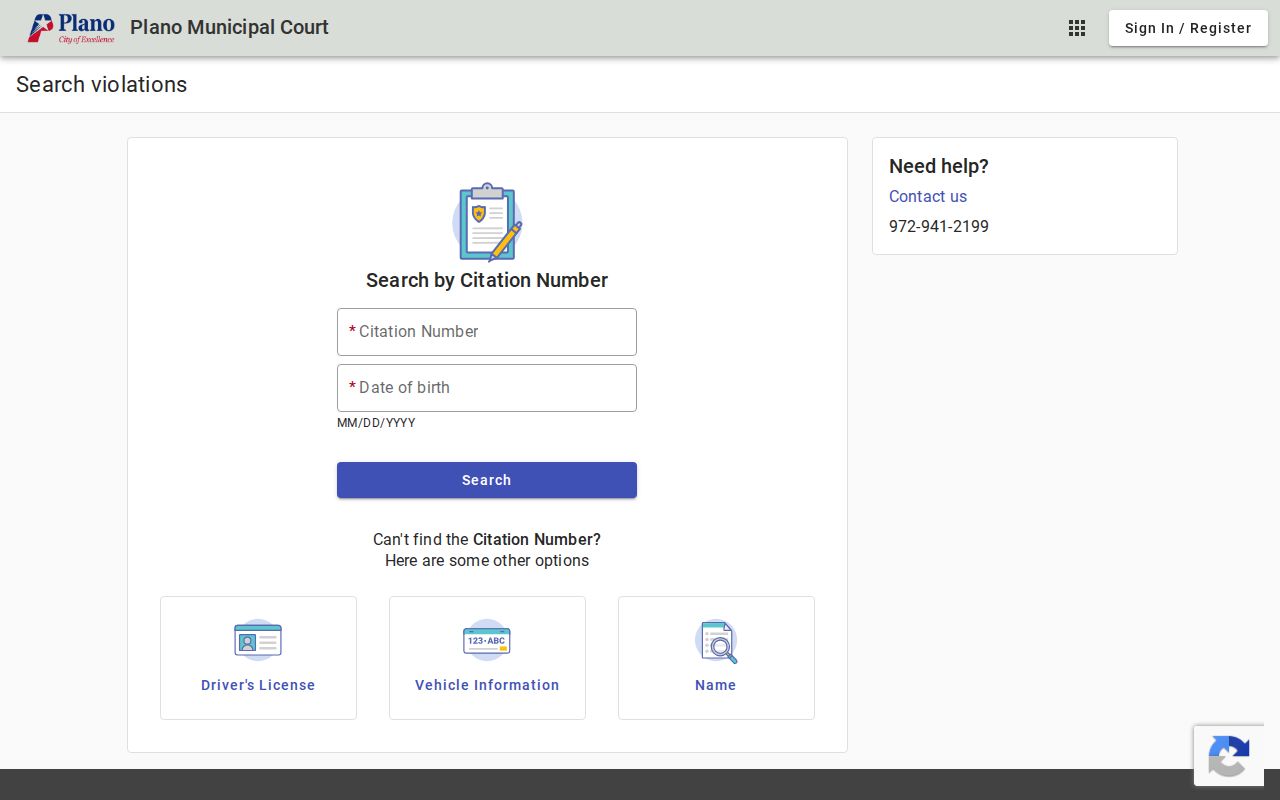
For a file beyond the indexed result, use the case number, court, and party context to ask the proper clerk for an available record.
Plano Vital Records Need Custodians
Birth, death, marriage, and divorce records follow different custody rules. Collin County Clerk or a local registrar issues local certified birth, death, and marriage records, while a divorce decree comes from the District Clerk where it was granted. Texas DSHS offers state copies, verification letters, and indexes. A verification or index can answer a limited name-and-event question, but it does not replace the local certified instrument.
Texas opens birth records after 75 years and death records after 25 years under the stated public-record rule, while certified copies remain qualification-controlled. The research records digital birth indexes from 1925 forward and death indexes from 1965 forward, with earlier microfiche available from 1903. DSHS lists marriage indexes since 1966 and divorce indexes since 1968. For newer records, use the holder's eligibility and order route rather than assuming a directory search will expose a certificate.
Historical Plano Resident Directories
Historical directories answer a different question from a current Plano record search: who was printed at a particular address or under a particular name in a given publication year? The verified local examples are the 1948 Plano City Directory and Polk's Plano City Directory for 1974, with a verified 1976 numerical-address page. Their value is a dated household, business, street, or occupation clue that can be compared with deeds, probate, obituaries, and census records.
Do not assume the verified years are a continuous run. The research did not safely establish the first or last Plano edition, the exact local shelf run, or the available reverse-directory years. The W.O. Haggard Library Genealogy Center, Collin County Genealogical Society, UNT, and the Texas State Library and Archives are the practical fallback chain. The Plano directory book focuses on reading the historical collections and their address sections.
Plano Directory Scans at UNT
CCGS and the UNT Portal to Texas History provide an unusually strong local history layer. At inspection, the partner page reported 4,240 items, including 26 city-directory items and 4,076 grouped with the Texas Digital Newspaper Program. Those are collection counts, not a promise that every Plano volume is digitized. Search full text, metadata, title, subject, creator, or names, then read the image before using a line as a resident clue.
The 1976 numerical section is a useful warning. Its OCR places a business, Plano Apartment Locator, alongside numbered-address and individual-name entries. OCR can merge lines or misread a surname. An old directory line should be classified as a person, business, household notation, or uncertain result before it is used to connect a family or address. The same rule applies to newspaper notices and obituaries.
The CCGS collection at UNT is the starting point for its searchable scans and related local newspapers.
Plano Street Names Across Records
Old street names can break an otherwise good Plano record search. The Houston & Texas Central Railway arrived in 1872, and Plano was platted in 1873 around a railroad-oriented grid. Historic material can therefore use names that do not match a current address. The city's official street-name sheet bridges Main with K Avenue, Mechanic with 15th Street, and Masonic with 15th Place, among many other aliases.
Preserve both forms in the research notes. Search the address section under the printed historical name, then compare the parcel's legal description, plat, or map before declaring a modern match. The research does not verify one citywide renumbering year, so a careful result uses the specific official alias instead of inventing a conversion rule. A 1890 Sanborn map can add a building or street-use checkpoint, but it is not a resident census.
Plano's historic street-name sheet supplies the local translation layer for those searches.
Plano ZIP Geography Is Different
ZIP code geography is postal geography, not a statement about the Plano city boundary or the people at an address. The county map identifies 75023, 75024, 75025, 75074, 75075, 75093, and 75094 among the Plano postal areas. It also shows 75097 as shared Plano and Weston geography. That makes a ZIP useful for narrowing a search but weak as proof of a city limit or current household.
Use USPS to normalize a mailing address, Plano GIS to check the municipal boundary, and CCAD for the parcel and appraisal context. The County Clerk's legal description adds the land-record link. USPS itself warns that a ZIP result does not confirm a person or company at an address. Once a ZIP has narrowed the area, move to an address and parcel rather than trying to infer a ZIP-wide resident list.
USPS ZIP Lookup provides address, city-and-state, and ZIP search modes for the postal step.
Plano Records Beyond Web Indexes
A search screen is only one access channel. County Clerk and court clerks provide public terminals and manual books, although exact terminal hours were not stated in the research. District Clerk requests can be made in person, by mail, or by email, and the Clerk does not perform phone name searches. County land copies can be ordered through the Clerk's form. For older directories, deeds, marriage, probate, newspapers, and microfilm, use Haggard, CCGS, UNT, or the Texas State Library and Archives rather than treating an empty web result as final.
The Texas Public Information Act lets any person request existing non-exempt government records. It does not require an office to create a custom people list or answer a research question. If an index falls short, name the record, department, address or document number, and date range. For city-created material such as a permit, map, or code record, send the request to Plano rather than the county. For county land or court material, direct it to the proper county custodian.
| Official route | Strength | Limit to remember |
|---|---|---|
| Official online index | Fast starting point for a named record or parcel | Coverage, images, and redactions can be incomplete |
| Clerk counter, terminal, mail, or copy request | Access to files, manual books, or official copies | May require a record number, fee, or processing time |
| Library and archive collections | Historical directories, newspapers, and microfilm | Item-specific holdings and on-site access can apply |
| Commercial people-search services | May surface leads from mixed data sources | Can be stale, incomplete, or a wrong-person match; official records control |
Collin County's public-records office map shows the custodian split between county, city, clerk, appraisal, tax, and law-enforcement records.
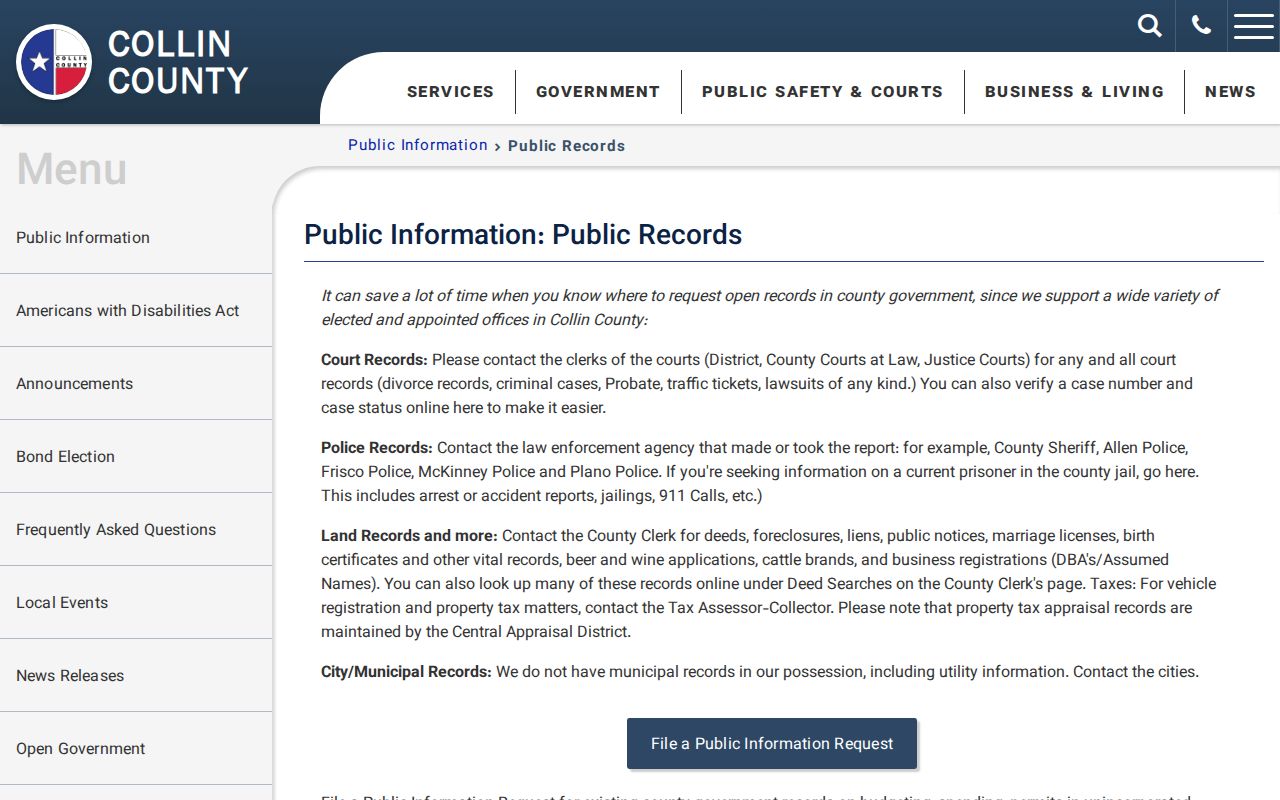
Choosing the correct custodian first prevents a county request from being sent for a municipal record, or a city question from being sent to the appraisal district.
Plano Privacy and Safe Research
Public availability has limits. Texas protects motor-vehicle personal information, sensitive voter data, protected voters, juvenile and sealed court records, victim information, and confidential vital material. The Texas Address Confidentiality Program supplies a substitute address to qualifying participants and can suppress protected location information. A web suppression request is not permission to rebuild a protected address from another source.
Correct an error with the office that maintains it: CCAD for an appraisal record, Elections for registration updates, a clerk for court or land-record questions, and DSHS or a local registrar for vital-record changes. Keep the record number and request date. That preserves a clear source trail while respecting the distinction between an open index and information that is protected, redacted, or simply not collected as a public resident directory.
Texas Address Confidentiality Program information explains the protection and application route.